Making Your Net Work Mastering the Art and Science Pdf
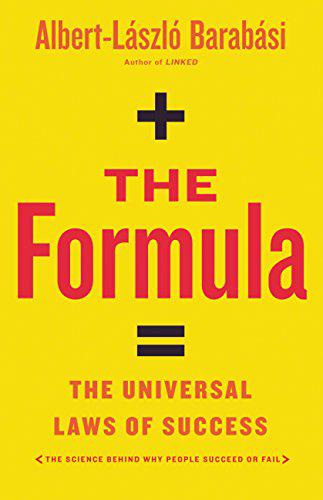
The Formula
Albert-Laszlo Barabasi
Too oft, accomplishment does not equate to success. Nosotros did the work but didn't get the promotion; we played difficult but weren't recognized; we had the thought but didn't go the credit. We've always been told that talent and a strong work ethic are the key to getting ahead, but in today's world these efforts rarely interpret into tangible results. Recognizing this disconnect, Laszlo Barabasi, one of the earth'southward leading experts on the science of networks, uncovers what success really is: a collective phenomenon based on the thoughts and praise of those around yous. In The Formula, Barabasi highlights the vital important of community respect and appreciation when connecting operation to recognition--the elusive link between functioning and success. By leveraging the power of big data and historic instance studies, Barabasi reveals the unspoken rules behind who truly gets ahead and why, and outlines the twelve laws that govern this phenomenon and how we can use them to our own advantage. Unveiling the scientific principles that drive success, this trailblazing volume offers a new understanding of the very foundation of how people excel in today'southward society.
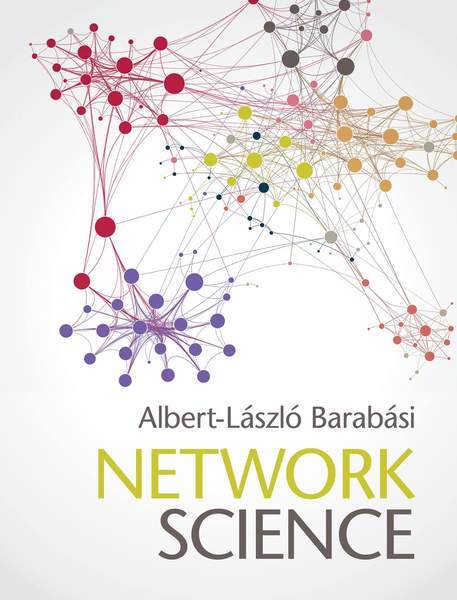
Network Scientific discipline
Albert-László Barabási
Networks are everywhere, from the Internet, to social networks, and the genetic networks that determine our biological existence. Illustrated throughout in full colour, this pioneering textbook, spanning a wide range of topics from physics to informatics, technology, economics and the social sciences, introduces network science to an interdisciplinary audition. From the origins of the six degrees of separation to explaining why networks are robust to random failures, the author explores how viruses like Ebola and H1N1 spread, and why it is that our friends accept more friends than nosotros practise. Using numerous existent-world examples, this innovatively designed text includes articulate delineation between undergraduate and graduate level cloth. The mathematical formulas and derivations are included within Avant-garde Topics sections, enabling utilise at a range of levels. Extensive online resource, including films and software for network assay, make this a multifaceted companion for anyone with an interest in network science.
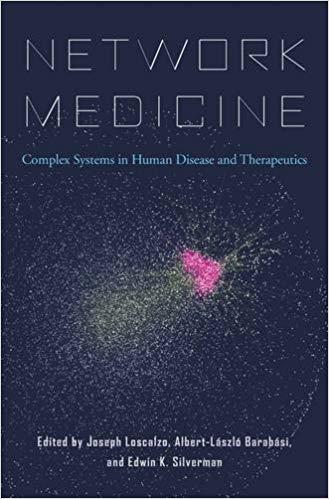
Network Medicine: Complex Systems in Human Illness and Therapeutics
Edited by Joseph Loscalzo, Albert-Laszlo Barabasi, and Edwin One thousand. Silverman
Big data, genomics, and quantitative approaches to network-based analysis are combining to accelerate the frontiers of medicine as never before. Network Medicine introduces this rapidly evolving field of medical research, which promises to revolutionize the diagnosis and treatment of human diseases. With contributions from leading experts that highlight the necessity of a squad-based arroyo in network medicine, this definitive volume provides readers with a state-of-the-art synthesis of the progress being made and the challenges that remain. Medical researchers take long sought to identify single molecular defects that cause diseases, with the goal of developing argent-bullet therapies to treat them. But this paradigm overlooks the inherent complication of human diseases and has often led to treatments that are inadequate or fraught with adverse side effects. Rather than trying to force disease pathogenesis into a reductionist model, network medicine embraces the complexity of multiple influences on disease and relies on many different types of networks: from the cellular-molecular level of protein-protein interactions to correlational studies of gene expression in biological samples. The authors offer a systematic approach to understanding circuitous diseases while explaining network medicine's unique features, including the application of modernistic genomics technologies, biostatistics and bioinformatics, and dynamic systems analysis of circuitous molecular networks in an integrative context. By developing techniques and technologies that comprehensively assess genetic variation, cellular metabolism, and protein function, network medicine is opening upward new vistas for uncovering causes and identifying cures of disease.
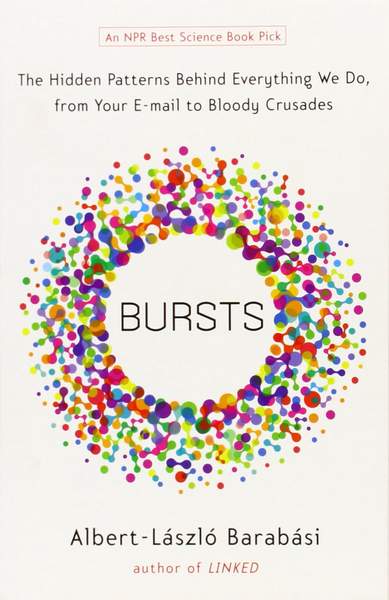
Bursts
Albert-László Barabási
Bursts: is well-nigh... The Subconscious Pattern Behind Everything We Exercise... A revolutionary new theory showing how we tin can predict human beliefs. Can we scientifically predict our future? Scientists and pseudo scientists have been pursuing this mystery for hundreds and perchance thousands of years. But now, astonishing new research is revealing patterns in human beliefs previously thought to exist purely random. Precise, orderly, anticipated patterns... Albert-László Barabási, already the world'southward preeminent researcher on the science of networks, describes his piece of work on this profound mystery in Bursts, a stunningly original investigation into homo nature in the lite of Big Data. His approach relies on the digital reality of our earth, from mobile phones to the Net and email, because it has turned society into a huge research laboratory. All those electronic trails of time stamped texts, voicemails, and internet searches add upwards to a previously unavailable massive data ready of statistics that track our movements, our decisions, our lives. Assay of these trails is offering deep insights into the rhythm of how we do everything. His finding? We piece of work and fight and play in short flourishes of activity followed by next to naught. The design isn't random, it's "bursty." Randomness does not dominion our lives in the fashion scientists have assumed upwardly until now. Illustrating this revolutionary science, Barabási artfully weaves together the story of a 16th century flare-up of human activeness-a bloody medieval crusade launched in his homeland, Transylvania-with the modernistic tale of a contemporary artist hunted by the FBI through our post nine/11 surveillance society. Barabási'southward astonishingly wide range of examples from seemingly unrelated areas include how dollar bills move around the U.S., the design everyone follows in writing email, the spread of epidemics, and even the flight patterns of albatross. Bursts reveals what this amazing new research is showing us about where private spontaneity ends and predictability in human behavior begins. The mode yous retrieve nigh your ain potential to do something truly extraordinary will never exist the same.
EDITORIAL REVIEWS
"Barabási is one of the few people in the earth who understand the deep structure of empirical reality." -Nassim Nicholas Taleb, author of The Blackness Swan "Barabási brings a physicist's penetrating eye to a sweeping range of human activities, from migration to web browsing, from wars to billionaires, from illnesses to letter of the alphabet writing, from the Department of Homeland Security to the Conclave of Cardinals. Barabási shows how a blueprint of bursts appears in what has long seemed a random mess. These bursts are both mathematically anticipated and cute. What a joy information technology is to read him. You feel like you have emerged to meet a new vista that, while information technology had always been there, yous had just never seen." -Nicholas A. Christakis, M.D., Ph.D., coauthor of Connected: The Surprising Power of Our Social Networks and How They Shape Our Lives "Bursts is a rich, rewarding read that illuminates a cut-edge topic: the patterns of human being mobility in an era of full surveillance. The narrative structure of Barabási'southward provocative volume mimics the very pattern of bursts, equally sharp jumps through the lives of a postal service-mod sculptor, a medieval Hungarian revolutionist, and Albert Einstein eventually converge on a single theme: that our unthinking behaviors are governed past a deeper meaning that can only be deciphered through the brave lens of mathematics." -Ogi Ogas, Ph.D., and Sai Gaddam, Ph.D., Boston Academy "Barabási, a distinguished scientist of circuitous networks, bravely tests his innovative theories on some historic events, including a sixteenth-century Crusade that went terribly wrong. Whether or not the concept of "burstiness" is the primal to unlocking human beliefs, it is nonetheless a fascinating new way to recall virtually some very former questions." -Thomas F. Madden, Ph.D., Professor of Medieval History, Saint Louis University, author of The New Curtailed History of the Crusades In his first book, Linked, Barabási introduced united states to the interrelatedness of the universe and to the emerging field of network science. Here, the physicist shows how to apply that noesis to predict seemingly random human behavior. Or the spread of a viral epidemic through populations. Or the convoluted trails that money follows. Similar the "unexplained" erratic movement of tiny objects floating through water that fascinated Einstein at the turn of the 20th century, credible stochasticity, says Barabási, can all be explained—and predicted—past elegant mathematical formulas. And for the start time in history, nosotros're beginning to take the right data to plug into such formulas. Using algorithms built in his lab, fueled past reams of data we unthinkingly create in our daily digital interactions (conveying around and communicating with mobile devices, withdrawing coin from ATMs, making online purchases), Barabási demonstrates how much of human activity occurs in quantifiable patterns known as "bursts." These bursts seem to ascertain us: from our emailing and web-browsing patterns to how nosotros movement most the world. Merely in Bursts, this realization surfaces only as the sum effect of a virtually-schizoid storyteller's account of historical and personal events. Driven past colorful characters and an experimental plot structure that jumps between ostensibly unrelated narratives, the book weaves a bloody cause, the papacy, 9/11, and FBI surveillance into a tidy package. The event is enthralling: less like listening to a lecture at a enquiry conference, and more like sitting at a bar with a clever friend who charms you with his semi-implausible anecdotes. Later nursing the terminal beer, beyond being amused, y'all'll have learned something truly profound most the curious paths of human action.
Seed Magazine
More Links
Questions & Answers with Albert-László Barabási
Marco Visscher, Ode: What is a practiced case of a burst? ALB: We may not even be aware of information technology, but each twenty-four hour period we participate in many small bursts. We originally discovered bursts in the email pattern of individuals. Indeed, if nosotros follow the sequence of emails sent past whatsoever person, we will not come across a random and uniform stream of letters that most previous theories of human advice predict--we will witness instead curt periods of intensive email activity, when the users fire out several, occasionally dozens of emails, followed by long periods of e-scientific discipline. Soon we started to see like bursts in all human activities that we could collect data for, from telephone calls to the financial transactions of stock brokers; from Wikipedia edits to visits to the library. What surprised us almost, nevertheless, was that all these bursty patterns followed the aforementioned precise mathematical police. We were seeing a peculiar rhythm of life that none of the individuals generating these bursts were enlightened of.
Marco Visscher, Ode: How practise bursts occur? ALB: At first it appeared that burst occur randomly merely nosotros before long learned that they accept a simple origin: prioritizing. Indeed, whether we practise it consciously or subconsciously, we prioritize, ofttimes many times each twenty-four hour period.As I show in Bursts, each fourth dimension people prioritize their tasks, their behavior becomes bursty. If, however, we let a die run our life, all signatures of burstiness disappear.
Marco Visscher, Ode: Can we predict the adjacent burst (when, what)? ALB: Yes and no. To be sure, our daily activity is far more predictable than we are frequently comfy of acknowledging, a major topic of the book. Consequently, we can in principle predict quite a number of things, from our whereabouts to potentially the timing of our e-mail messages. While nosotros know exactly our predictability when it comes to where we are (and it is frighteningly high), we have not yet tried to predict bursts. It may not be incommunicable.
Marco Visscher, Ode: How does the idea of bursts change the fashion nosotros look at society? ALB: We oft retrieve of the society as a smooth mechanism with its internal clock, where events proceed more or less seamlessly forth their tracks. In reality, most events follow a bursty pattern, which, if understood, will alter the way we approach them, and the fashion nosotros get things done. Bursts is not a self-help book, merely I believe that if we sympathise the patterns behind the rhythm of our daily activeness, we are in much better position to be in tune with them and eventually practice control over them. It has certainly changed they way I bargain with the people I work with-- if we are stuck, the most remedy comes through revisiting our priorities, rather than placing blame. Marco Visscher Managing Editor
ODE Mag | FOR INTELLIGENT OPTIMISTS
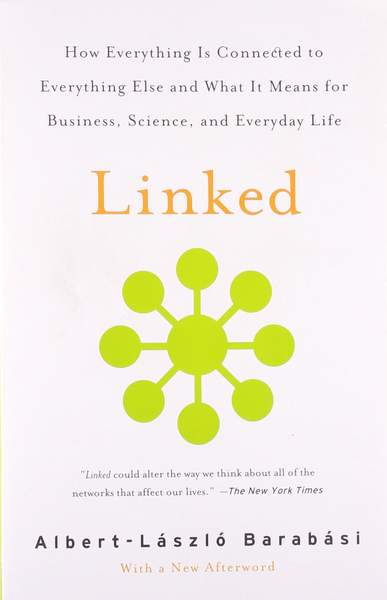
Linked
Albert-László Barabási
In the 1980's, James Gleick's Chaos introduced the world to complexity. Albert-László Barabási'south Linked reveals the next major scientific jump: the report of networks. Nosotros've long suspected that nosotros alive in a small world, where everything is connected to everything else. Indeed, networks are pervasive--from the human encephalon to the Net to the economy to our grouping of friends. These linkages, it turns out, aren't random. All networks have an underlying society and follow elementary laws. Agreement the structure and behavior of these networks will help us do some amazing things, from designing the optimal organization of a firm to stopping a disease outbreak earlier information technology spreads catastrophically.In Linked, Barabási, a physicist whose work has revolutionized the study of networks, traces the evolution of this chop-chop unfolding science and introduces us to the scientists carrying out this pioneering piece of work. These "new cartographers" are mapping networks in a wide range of scientific disciplines, proving that social networks, corporations, and cells are more than similar than they are different, and providing important new insights into the interconnected globe effectually us. This cognition, says Barabási, tin can shed low-cal on the robustness of the Internet, the spread of fads and viruses, fifty-fifty the futurity of commonwealth. Engaging and administrative, Linked provides an heady preview of the next century in science, guaranteed to be transformed past these amazing discoveries.
Table of Contents
Downloadable contents
Introduction
pdfHalf dozen Degrees of Separation
pdfThe Rich Get Richer
pdfNetwork Economy
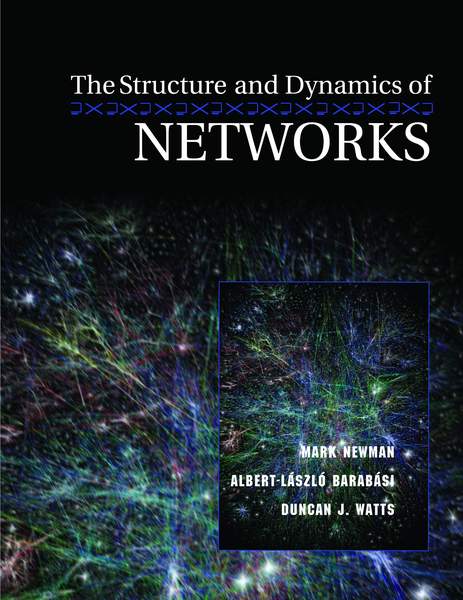
The Structure and Dynamics of Networks
Albert-László Barabási, Mark Newman, Duncan J. Watts
From the Net to networks of friendship, disease transmission, and fifty-fifty terrorism, the concept--and the reality--of networks has come up to pervade modern social club. But what exactly is a network? What dissimilar types of networks are there? Why are they interesting, and what can they tell us? In recent years, scientists from a range of fields--including mathematics, physics, computer science, folklore, and biology--have been pursuing these questions and edifice a new "science of networks." This book brings together for the first time a set of seminal articles representing research from across these disciplines. It is an ideal sourcebook for the fundamental research in this fast-growing field. The book is organized into four sections, each preceded by an editors' introduction summarizing its contents and full general theme. The first section sets the stage past discussing some of the historical antecedents of contemporary inquiry in the area. From in that location the book moves to the empirical side of the scientific discipline of networks earlier turning to the foundational modeling ideas that have been the focus of much subsequent activity. The volume closes past taking the reader to the cutting edge of network science--the human relationship between network structure and system dynamics. From network robustness to the spread of disease, this section offers a potpourri of topics on this speedily expanding frontier of the new science.
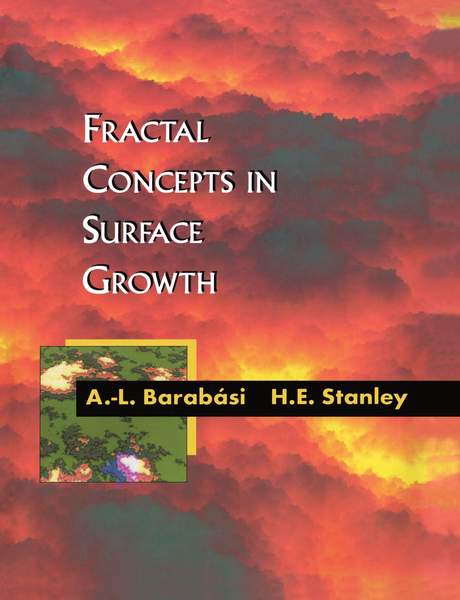
Fractal Concepts In Surface Growth
Albert-László Barabási, H.East. Stanley
Fractals and surfaces are 2 of the about widely-studied areas of modernistic physics. In fact, most surfaces in nature are fractals. In this book, Drs. Barabási and Stanley explain how fractals can exist successfully used to describe and predict the morphology of surface growth. The authors begin past presenting basic growth models and the principles used to develop them. They side by side demonstrate how models can be used to answer specific questions about surface roughness. In the 2nd half of the book, they talk over in particular two classes of phenomena: fluid catamenia in porous media and molecular beam epitaxy (MBE). In each example, the authors review the model and belittling approach, and present experimental results. This book is the start attempt to unite the subjects of fractals and surfaces, and it will appeal to advanced undergraduate and graduate students in condensed matter physics and statistical mechanics.
hendersonthrusled.blogspot.com
Source: https://barabasi.com/book/network-science
0 Response to "Making Your Net Work Mastering the Art and Science Pdf"
Post a Comment